
CHLOE ZOLA | CHLOE ZOLA FEATURED ON SIX QUESTIONS WITH CHRISTINE!
February 17, 2026
We’re so excited to share this wonderful interview with #lcmartist Chloe Zola by Christine Goucher for ‘Six Questions With Christine’ — “Drawing as a Way of Thinking. A conversation with Chloe Zola.”
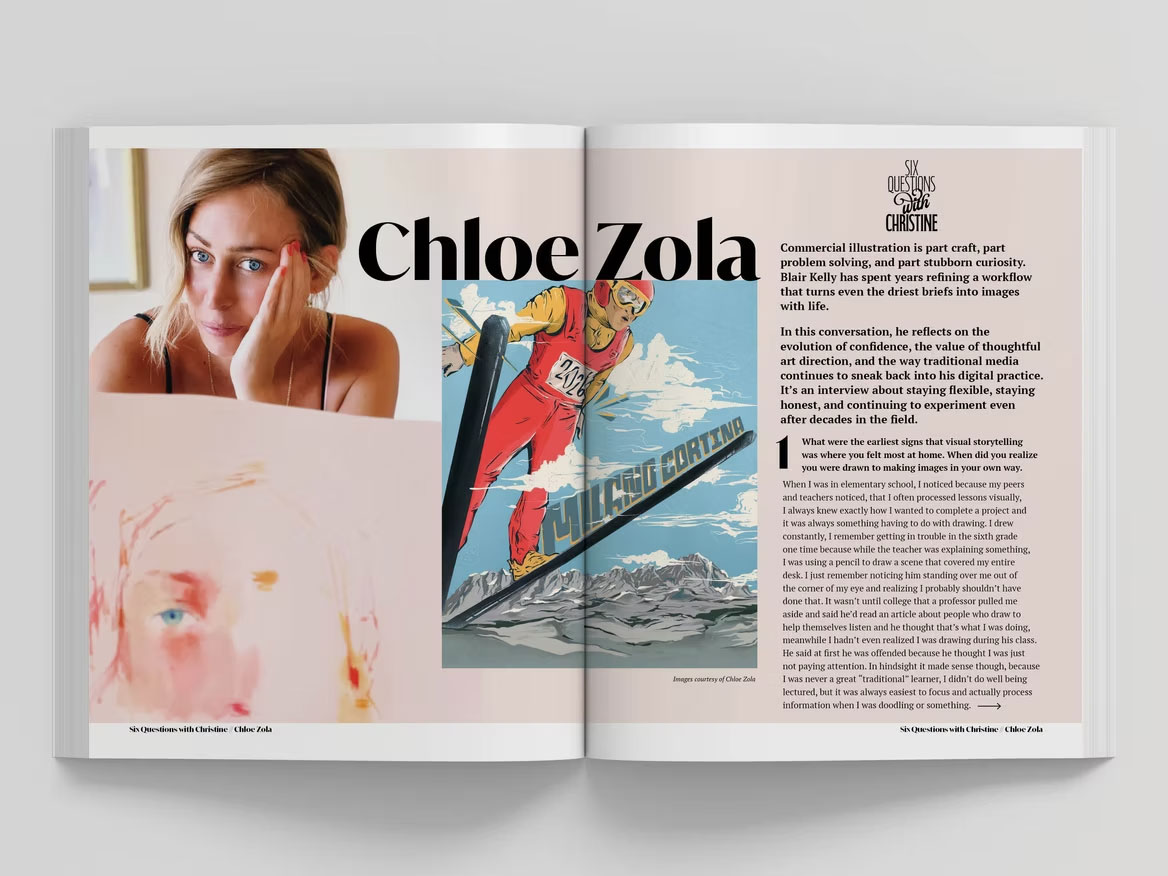 Chloe Zola has always processed the world visually. Drawing was how she listened, learned, and stayed engaged long before she had words for it. Today, her practice moves between illustration, photography, and more conceptual work, but the starting point is almost always the same. A feeling. Chloe imagines the final image first and lets the emotion it carries pull the work forward. In this conversation, we talk about drawing as a way of thinking, becoming more decisive as time gets tighter, how motherhood has shifted her point of view, and why emotion is the thing that keeps her invested in the work.
-
What were the earliest signs that visual storytelling was where you felt most at home. When did you realize you were drawn to making images in your own way.
When I was in elementary school, I noticed because my peers and teachers noticed, that I often processed lessons visually, I always knew exactly how I wanted to complete a project and it was always something having to do with drawing. I drew constantly, I remember getting in trouble in the sixth grade one time because while the teacher was explaining something, I was using a pencil to draw a scene that covered my entire desk. I just remember noticing him standing over me out of the corner of my eye and realizing I probably shouldn’t have done that. It wasn’t until college that a professor pulled me aside and said he’d read an article about people who draw to help themselves listen and he thought that’s what I was doing, meanwhile I hadn’t even realized I was drawing during his class. He said at first he was offended because he thought I was just not paying attention. In hindsight it made sense though, because I was never a great “traditional” learner, I didn’t do well being lectured, but it was always easiest to focus and actually process information when I was doodling or something.
-
You move between illustration, photography, and more conceptual work. When you start something new, what usually comes first for you, a feeling, a colour, a gesture, a scene, or a question. How does that first spark help decide where the piece wants to go.
-
I usually imagine a final product first, as weird as that may sound. And the idea of what the final product looks like, the way it makes me and potentially other people feel, that propels me forward. I would say everything I do, when it comes to creative projects, has to have a strong emotion tethering it, it definitely starts with a feeling. I’ve always had a tendency to imagine things much grander and larger and possibly more important than they end up being, but it’s a powerful motivator, lol! If there’s no emotion, I won’t be excited about it and probably won’t finish it.
-
As you keep growing your practice, have you noticed anything shifting in your approach or in the way you enter a piece that feels meaningful to you right now.
I think as life gets busier and I have less time than I had, say, in my 20’s or something to tinker around with ideas, when I do something I have to be more decisive and more sure of myself and the piece/concept than I did before. It’s like there’s less time to get better work done, I do well in a high-pressure situation so I think it works.
-
Your work often feels emotionally rooted. What kinds of moments, places, or relationships tend to filter into your images, whether you notice it or not.
This has changed a lot over the years, for a long time I think social justice was a common thread through much of my work, but now that I have a three year old, my POV is much lighter. As much as I love to do poingant, sometimes politically minded pieces, my head is just in toddler-land most of the time now so I find my work to be more playful than it’s been in prior years.
-
Has there been a project or a single image that surprised you, either in how it formed on the page or in the way someone else connected with it.
I think the cover I did for the YA book “When We Make It” by Elisabet Velasquez is one that surprised me just because I felt it ended up accompanying the heart of the story so well. It’s an important story and I felt really proud that the cover illustration communicated, at least in part, its essence.
-
When you need to come back to yourself creatively, what helps. A rhythm, a walk, a quiet practice, or a corner of your process that feels grounding.
Honestly, I find it very inspiring to scroll instagram and see what other artists are up to- photographers, illustrators, painters, it doesn’t matter. For better or worse it motivates me to see other artists fulfilling their potential, it’s like a kick in the pants. I can’t go on there without seeing something exciting and then subsequently coming up with a project I want to do immediately.
What stayed with me after reading Chloe’s answers was how clearly she described drawing not as a habit, but as a way of paying attention. She wasn’t distracted in those early classrooms. She was listening in the way that made sense to her. There’s also something quietly reassuring in the way she talks about decisiveness. Less time doesn’t automatically mean less creativity. In her case, it has sharpened her instincts and helped her trust her ideas more quickly. Chloe’s work is a reminder that emotion isn’t something to polish out of creative practice. It’s often the engine that gets the work finished at all.
 Previous