
VIDHYA NAGARAJAN | NEW INTERVIEW | SIX QUESTIONS WITH CHRISTINE
March 03, 2026 Vidhya Nagarajan
Excited to report that #lcmartist Vidhya Nagarajan is featured in Six Questions With Christine! “The Practice of Noticing.” Learn more about Vidhya simplifying her work, using limited colors and letting the art speak for itself.
Vidhya Nagarajan has always liked making things, but drawing became something more when it started to feel like a language. A way to respond to text, ideas, and the world around her.
Her work moves across editorial illustration, lettering, teaching, comics, and longer visual essays. What ties it all together is attention. To people, to small details, to the everyday moments that often slip by unnoticed. Recently, her practice has been shifting toward restraint, fewer colours, clearer compositions, and letting the drawing itself do more of the work.
In this conversation, we talk about learning through observation, simplifying the work, the surprising clarity that can come from tight timelines, and why stepping away from routine is sometimes the most important creative move.
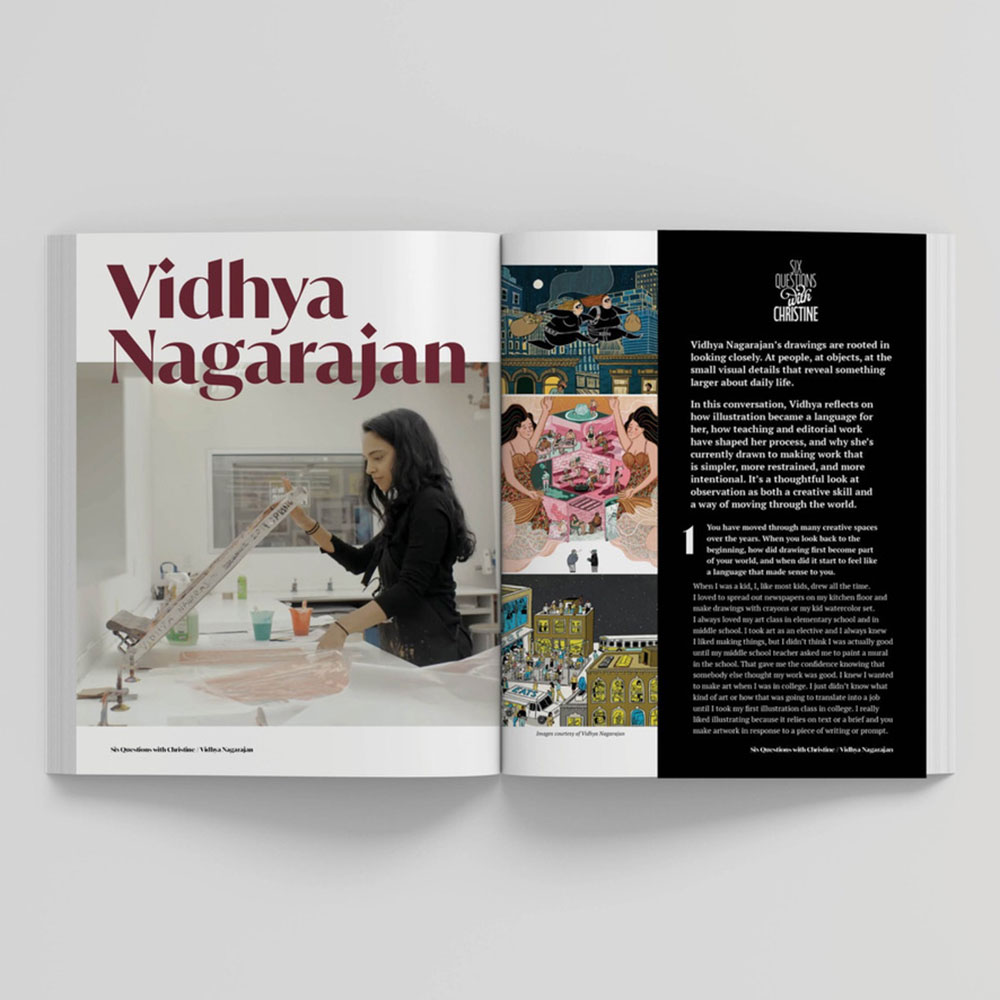
-
You have moved through many creative spaces over the years. When you look back to the beginning, how did drawing first become part of your world, and when did it start to feel like a language that made sense to you.
When I was a kid, I, like most kids, drew all the time. I loved to spread out newspapers on my kitchen floor and make drawings with crayons or my kid watercolour set. I always loved my art class in elementary school and in middle school. I took art as an elective and I always knew I liked making things, but I didn’t think I was actually good until my middle school teacher asked me to paint a mural in the school. That gave me the confidence knowing that somebody else thought my work was good. I knew I wanted to make art when I was in college. I just didn’t know what kind of art or how that was going to translate into a job until I took my first illustration class in college. I really liked illustrating because it relies on text or a brief and you make artwork in response to a piece of writing or prompt.
-
Your work holds ideas with such clarity and playfulness. When you begin something new, what helps you figure out how the idea wants to live on the page
I’ll try to think of a soultion that will answer the brief in a way that is not an exact translation of something that appears in the text. I’m also thinking about personally what I would like to accomplish in this illustation. What or how do I want to draw that would also communicate an idea that needs to be presented to the reader, viewer, buyer? Then, I will always start with a very loose sketch. It mostly looks like scribbles. Here, I’m trying to figure out the composition for the dimensions that I am given. After the composition is resolved, I’ll finalize the drawing and add colour, which I try to keep limited, since my drawings are usually pretty dense.
-
You work across editorial assignments, lettering, teaching, comics, and longer visual essays. As you move between these worlds, have you noticed anything in your process or style evolving in a way that feels meaningful to you right now.
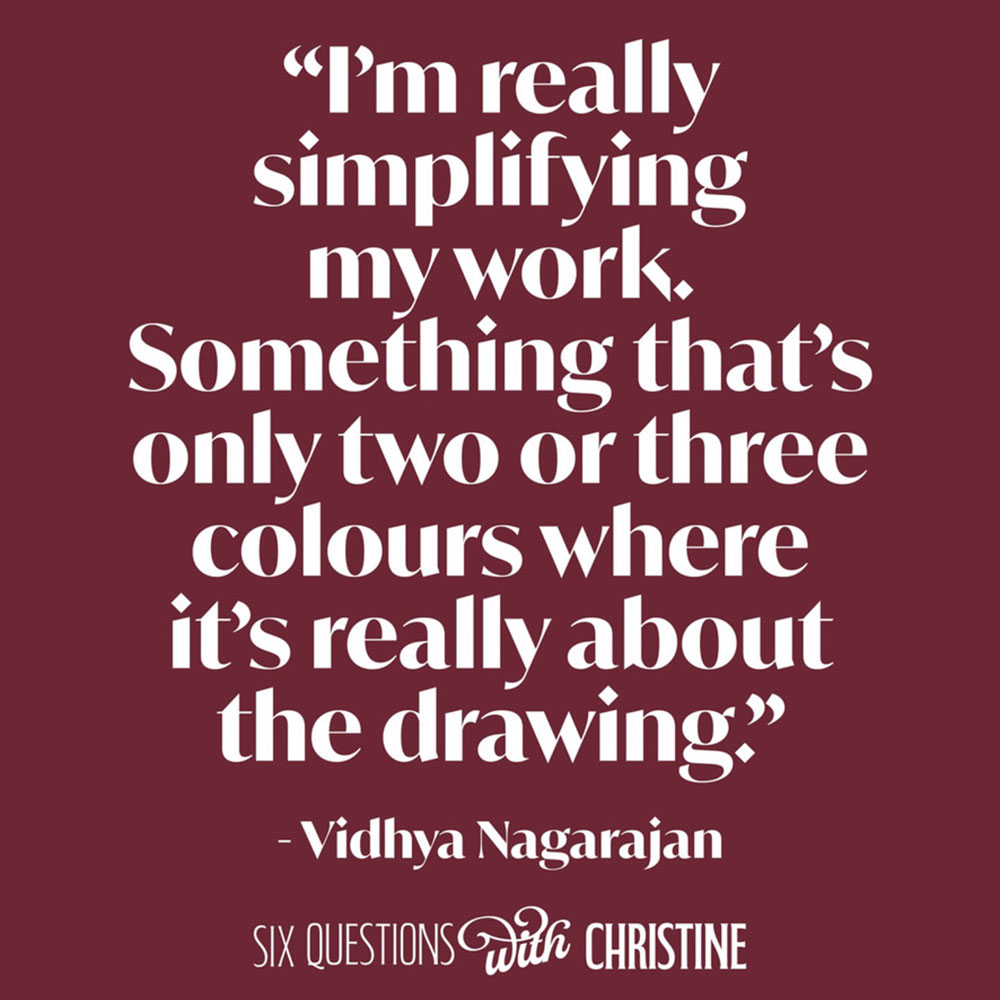
Right now I’m really simplifying my work. I have a tendency to do too much. Or have all my line drawings filled in almost like a colouring book but I like the work that I’m making that’s more restrained. Something that’s only two or three colours where it’s really about the drawing and not so much the filling in of the drawing. I still like that way of making, but sometimes I can feel like I’m coloring in a coloring book.
-
You have a generous eye for people and for the small details of daily life. What kinds of moments or memories tend to spark something in you, the things that make you want to pick up a pen and explore them.
I like people watching. I like to look at a person’s cool outfit or they’re interesting glasses or they’re unusual hairstyle. The things that they’re holding in their hands and try to remember them. Take a mental snapshot of them and try to draw them later when I get home. This is what I like to explore in my sketchbook. I’m not someone who gets a lot of enjoyment from drawing purely from my imagination. Most of the things that I draw have been observed at one time or another.
-
You navigate both quick editorial turnarounds and slower, more reflective work. Has a project ever surprised you, either in how you solved it or in the way someone connected with it.
Yes—often the projects with the tightest timelines end up being the most surprising. When I’m working quickly, especially on editorial assignments, I don’t have time to overthink decisions. I don’t have the luxury of overthinking, and that sometimes leads to clearer solutions.
-
Teaching, illustrating, and making personal work all ask for different parts of you. When you feel stretched, what helps you return to your own creative centre.
Going off of routine. Taking breaks are needed. Doing things that have nothing to do with illustrating, drawing or thinking about work. Being an artist, illustrator and instructor are parts of who I am but it’s not the whole thing. I love traveling. I love eating new foods. I like spending time with my friends and family. I love watching movies or TV, running, and learning a new language. So when I feel like I’m stretched and if time allows it, I like to do one of those other things.
Bonus Quetions: If you sat down to draw a world for yourself, what would you put in it just because it makes you smile.
That’s hard because there is a lot to include. But, some things I would draw: Really nice interiors with great lighting and beautiful furniture. Dense cities, occupied by smartly dressed people that are also filled with restaurants, markets and cafes that have beautiful food. Jungles, deserts, mountains and beaches that were never touched by humans. No roaches or mosquitos.
What stayed with me after reading Vidhya’s answers was how much of her work begins with noticing. Not inventing, not embellishing, but paying attention to what’s already there.
There’s also something freeing in the way she talks about restraint. Choosing fewer colours. Leaving space. Letting the drawing carry the idea instead of filling everything in. It’s a reminder that clarity often comes from doing less, not more.
Vidhya’s practice makes the case for observation as a creative muscle. One that gets stronger the more you use it.
To see more of Vidhya’s work, check out her website: https://www.vidhyanagarajan.com/
 Previous